Building symmetric coils with implicit-quotient beam search
Before the improvements described here, the following were the best known lengths for the snake-in-the-box, coil-in-the-box, and symmetric coil-in-the-box problems, in dimensions 9 ≤ n ≤ 13: (sourced from www.minortriad.com)
| n | snake | coil | symmetric coil |
|---|---|---|---|
| 9 | 190 | 188 | 186 |
| 10 | 376 | 370 | 362 |
| 11 | 737 | 728 | 674 |
| 12 | 1465 | 1442 | 1222 |
| 13 | 2898 | 2832 | 2354 |
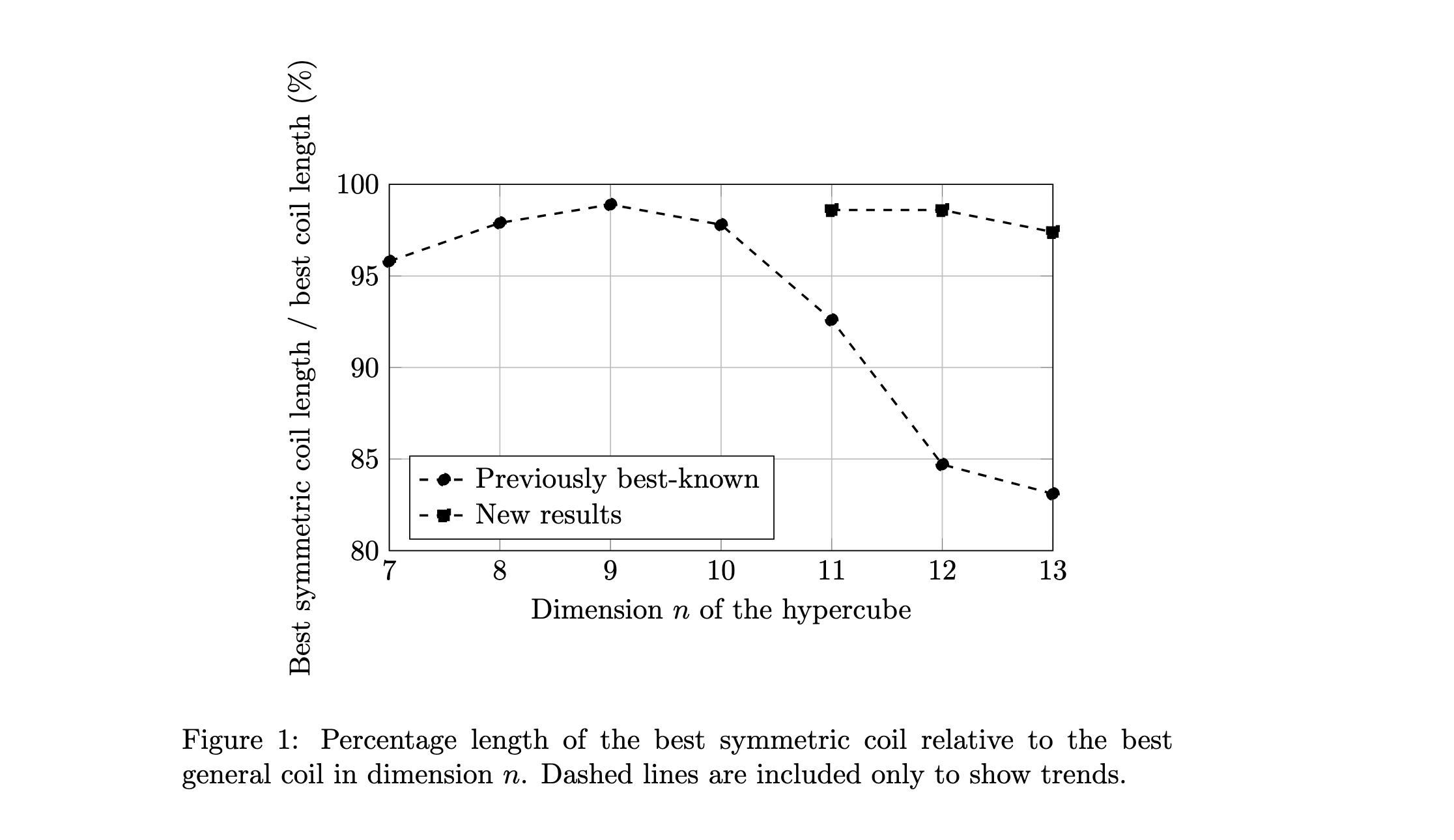
In dimensions n ≤ 10, the longest known symmetric coils are approximately the same length as the longest known snakes and coils. After the 10th dimension, the lengths of the best-known constructions for these problems deviate significantly, as shown by the percentage of best-known symmetric coil versus best-known (general) coil:
| n | (previous-best symmetric coil) / (best-known coil) |
|---|---|
| 7 | 95.8% (46/48) |
| 8 | 97.9% (94/96) |
| 9 | 98.9% (186/188) |
| 10 | 97.8% (362/370) |
| 11 | 92.6% (674/728) |
| 12 | 84.7% (1222/1442) |
| 13 | 83.1% (2354/2832) |
For n ≤ 6, proven optimal coils and symmetric coils have the same length. Experimentally, several of the best-known symmetric coils are exactly length 2 shorter than best-known general coils; this is the case in dimensions 7, 8, and 9.
Findings
Given the unexplained percentage decrease and structural potential of symmetric coils, I investigated approaches to build larger explicit constructions. Using an implicit-quotient beam search, I improved the best known symmetric-coil lengths in dimensions 11, 12, and 13.
| n | previous-best length | new coil length | % of general coil |
|---|---|---|---|
| 11 | 674 | 718 | 92.6% → 98.6% |
| 12 | 1222 | 1422 | 84.7% → 98.6% |
| 13 | 2354 | 2766 | 83.1% → 97.7% |
Notably, the lengths of these symmetric coils are approximately 97-98% of the length of the best-known general coils in their dimensions, which aligns with previous empirical results for smaller n.
Implicit-quotient beam search
The vertices of the n-cube can be naturally labelled with the vectors of . For the sake of simplicity, I will refer to vertices by their vector label. Two vertices are adjacent if where denotes Hamming weight. We denote the neighbors of a vertex as . A symmetric coil is an induced cycle over such that for some fixed . If and are consecutive vectors in , then . If and are non-consecutive vectors in , then .
The key symmetry is translation by : each vertex is naturally paired with . This gives an order-2 symmetry group acting on the -cube. Rather than search the full cube, we search modulo this symmetry, so vertices are treated as orbit pairs, with the goal of finding a long half-path such that . This quotient perspective is closely related to Wynn's work on permuted circuit codes.
Conceptually, we want to choose such that is small in order to minimize interference between halves. In fact, the smallest valid weight is 3 to construct a symmetric coil with length longer than 4. The actual coordinates set to 1 are arbitrary, as any with equivalent weight is equivalent up to relabeling.
For the actual search algorithm targeting the -cube, we warm-start with the first transitions from the half-sequence of an existing -symmetric coil. Priming the search with lower-dimensional seeds is a strategy adapted from Ace's recent record constructions for snakes and coils. By convention, . Then, we build a blocked bitmap of invalid vertices and set the head to the last vertex of the seeded path.
Along with each candidate , the algorithm also considers its pair for the second-half . In particular, if a candidate is chosen to follow to the current head , then all of the following must be blocked: . Closure is determined when the chosen candidate satisfies . Candidates are evaluated from using a beam search. Saved states for the beam are determined by a heuristic which attempts to minimize the number of new forbidden vertices (and thus maximally "reuse" the existing blocked vertices) with a bias to keep eventual traversal to possible.
Using this method, the symmetric coils presented under Findings were generated with relatively small RAM usage (< 4GB) with a cumulative computation time under 2 hours on an Intel i5-10600k. Beginning with a 362-length 10-d symmetric coil from Meyerson et al., we built our 11-d symmetric coil, which then seeded our 12-d symmetric coil, which then seeded our 13-d symmetric coil. Meyerson et al.'s 10-d symmetric coil used which we inherited for each of our results.
References
- Meyerson, S.J., Drapela, T.E., Whiteside, W.E., Potter, W.D., "Finding Longest Paths in Hypercubes, 11 New Lower Bounds: Snake, Coils, and Symmetric Coils", Proceedings of the 28th Industrial, Engineering and Other Applications of Applied Intelligent Systems, LNAI-9101: Current Approaches in Applied Artificial Intelligence, Springer International, pp. 23-32.
- E. Wynn, "Constructing circuit codes by permuting initial sequences", arXiv:1201.1647v1 (2012).
- Ace, T. (2026). "Priming Snake-in-the-Box Search with Seed Snakes in n-1 and n-2 Dimensions," Zenodo. doi:10.5281/zenodo.20753867
Last updated July 2, 2026